
If Your Home Feels “Off,” Here’s the Design Fix You’re Missing
3/11/20263 min read
She stood in the middle of the room with her arms crossed.
“I don’t get it,” she said.
The couch was new. The rug matched the pillows. The coffee table had just been delivered two weeks earlier. She had even hung the art exactly how the internet said to.
And yet…
The room still felt wrong.
Not messy. Not ugly. Just… off.
If you’ve ever walked into your living room and felt that quiet irritation — like something isn’t clicking but you can’t explain why — I want you to know you’re not imagining it.
Your brain is picking up on something your eyes haven’t learned to name yet.
And the reason almost always comes down to one missing thing:
visual hierarchy.
Once you see it, you can’t unsee it.
Why Your Brain Feels Tired in Certain Rooms
Your brain is constantly scanning your environment looking for patterns.
It wants to understand three things quickly:
• What matters most here
• Where should my eyes land
• How do I move through this space
When a room lacks those answers, your brain works overtime trying to make sense of it.
That’s when a room feels “off.”
Designers call this a lack of visual hierarchy.
But the feeling is simpler than the term.
Imagine walking into a conversation where five people are talking at the exact same volume.
No pauses. No leader. No rhythm.
You’d feel overwhelmed immediately.
Rooms work the same way.
When every piece of furniture, decor item, and wall feature is fighting for attention, your brain can’t settle.
A calm room gives your eye a place to land.
Let’s talk about how to create that.
Every Room Needs a Main Character
One of the first things I look for when I walk into a space is this:
What is the room about?
If the answer isn’t obvious within a few seconds, the room will feel unsettled.
Most living rooms already have a natural main character.
It might be:
• The sofa
• A fireplace
• A large window
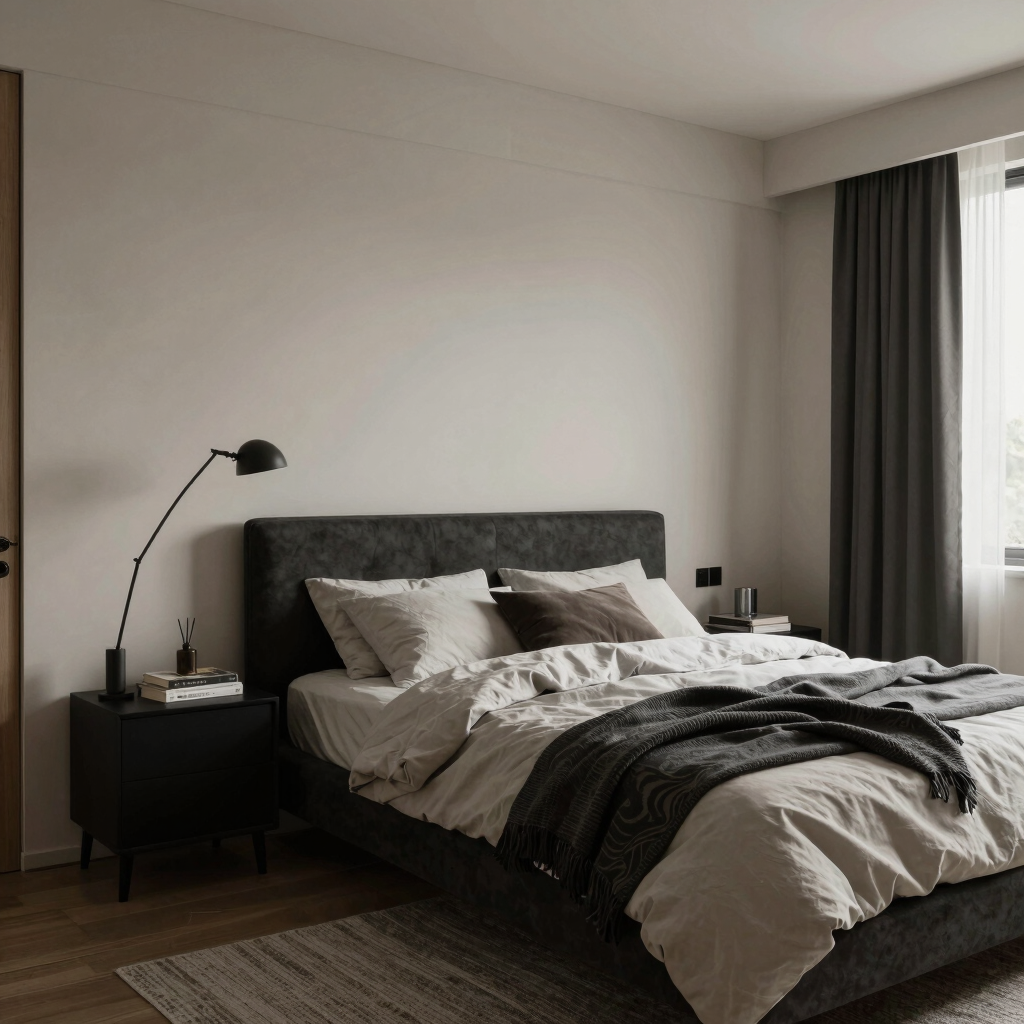
• The bed in a bedroom
• A dining table
But here’s the problem most homes run into.
The main character gets buried.
Too many competing pieces start shouting for attention.
Gallery walls that spread across multiple surfaces. Accent chairs placed at awkward angles. Decor scattered evenly everywhere.
When everything is highlighted, nothing stands out.
The 60–30–10 Rule Designers Quietly Use
Here’s a simple framework many designers follow instinctively.
Think of visual attention like percentages.
• 60% of the visual weight should belong to your anchor piece • 30% supports it (chairs, rugs, side tables) • 10% adds personality (decor, styling, smaller accents)
When decor starts creeping past that 10%, the room becomes visually noisy.
Your brain senses the imbalance immediately.
The more decor you add, the more structure you need.
Structure first. Personality second.
The “Competing Corners” Problem
Another subtle issue I see constantly is what I call competing corners.
Picture this:
A lamp in one corner. A tall plant in another. A bookshelf across the room. A gallery wall above the sofa.
Each area becomes its own little moment.
Individually they’re beautiful.
Together they scatter your attention across the room.
Your brain has to bounce between them instead of resting in one place.
Here’s a simple fix you can try today:
Stand at the entrance of your living room.
Ask yourself:
Where do my eyes go first?
If the answer changes every time you walk in, the room needs simplification.
Try removing one competing element.
You’ll be shocked how quickly the room settles.
The Power of Intentional Contrast
Contrast is another tool designers use to guide your eye.
Without contrast, everything blends together.
With too much contrast, the room becomes chaotic.
The sweet spot is intentional pairing.
Examples you can implement today:
• A light sofa against a slightly darker wall
• A textured throw on a smooth chair
• A bold art piece above a simple console
Contrast tells your eye where to pause.
And pause creates calm.
The One-Minute Reset Test
If your room feels off, try this small experiment.
Remove three items from the room.
Not forever. Just temporarily.
A stack of decor books. A side chair. An extra lamp.
Now step back and notice the shift.
Most people immediately feel the difference.
The room suddenly has breathing space.
Your brain processes it faster.
Clarity replaces tension.
That’s the power of hierarchy.
When a Room Finally Clicks
When visual hierarchy is working, something subtle happens.
You walk in and your shoulders drop a little.
Your eyes land naturally on the focal point. Movement through the room feels intuitive.
You stop adjusting things every weekend because the space finally feels… finished.
Not because it’s perfectly styled.
But because it makes sense.
And once you understand this principle, you’ll start seeing it everywhere — in magazines, in homes, even in restaurants designed to feel calm and welcoming.
Inside Your Space Simplified, I walk you through how to create this structure in every room so you’re not guessing why a space feels wrong.
Because when you understand hierarchy, contrast, and focal points, you stop decorating randomly.
You start designing with intention.
And that’s when your home begins to feel the way you always hoped it would.
Your guide is on it's way!
© 2026 Elegant Living Co. All rights reserved.
All content on this website — including but not limited to text, guides, templates, graphics, and design concepts — is the intellectual property of Elegant Living Co and may not be copied, reproduced, distributed, or shared without written permission.
Terms and Conditions:
By using this website and purchasing from Elegant Living Co, you agree to our terms. All content, digital products, and design materials are the intellectual property of Elegant Living Co. and may not be copied or shared without permission. Design services are based on client-provided information. Elegant Living Co is not responsible for inaccuracies, third-party purchases, or installation outcomes. We reserve the right to update services, pricing, and policies at any time.
Refund Policy:
All digital product sales are final due to instant access. Design services are non-refundable once work has begun. Cancellations made before the start date may be eligible for partial refund at our discretion. If you have any issues with your purchase, please reach out — we’re here to help.
FREE: Make Your Room Look Expensive
Steal my designer checklist for creating a polished, timeless room without the designer price tag.
☑ Furniture placement
☑ Rug sizing
☑ Lighting
☑ Curtains
☑ Styling
☑ Designer finishing touches
Plus occasional affordable decorating tips and Elegant Living Co. updates. Unsubscribe anytime.
Your interior design bestie